 Gaojia Optotech
Optical Characteristics of Eyepieces
An eyepiece is a special optical component of telescopes, microscopes and other visual optical instruments, with the human eye serving as the receiving terminal. In operation, the exit pupil of the eyepiece coincides with the pupil of the human eye and is located outside the eyepiece.
The function of an eyepiece is to magnify the real image formed by the objective lens for the second time, and form the final image at infinity or the near point of distinct vision for human observation.
The main optical characteristics of eyepieces are as follows:
1. Focal length of eyepiece
An eyepiece operates on the same principle as a magnifying glass. Its focal length is related to magnification: the shorter the focal length, the higher the magnification.
There is a minimum limit to the focal length of an eyepiece. The focal length of common eyepieces is generally about 15~30 mm.
2. Field of view of eyepiece
The field of view of an eyepiece is determined by the visual magnification of the optical system and the field angle of the objective lens.

Increasing the magnification of the system or enlarging the field angle of the objective lens will both increase the field angle of the eyepiece, which also involves structural selection and aberration correction.
The correction of off-axis aberrations of the eyepiece is the key of optical aberration design. For observation eyepieces, the exit pupil is arranged outside the lens structure. The ray height of off-axis field beams incident on each surface of the eyepiece is relatively high, which raises the difficulty of aberration correction and makes the eyepiece structure tend to be complicated.
The field angle of ordinary eyepieces is about 40°~50°; that of wide-angle eyepieces can reach 60°~80°, and super-wide-angle eyepieces have a field angle above 90°.
1. Aperture Stop of Eyepiece
The aperture stop of an eyepiece generally coincides with that of the objective lens, and its size corresponds to the exit pupil diameter.
For most optical instruments, the exit pupil diameter is equivalent to the human pupil diameter, approximately 2–4 mm. The exit pupil diameter of measuring instruments is less than 2 mm to improve aiming accuracy. Military instruments adopt a larger exit pupil diameter to adapt to observation under jitter conditions; the exit pupil diameter of tank sights is about 8 mm.
2. Eye Relief of Eyepiece
The ratio of eyepiece exit pupil distance to focal length is defined as relative eye relief, denoted by \(p'/f'\).
Since the position of the exit pupil is close to the rear focal point of the eyepiece, the eye relief \(p'\) is approximate to the intercept of the focal point.
For an eyepiece with a fixed structure, the focal position is determined, so the relative eye relief is approximately a constant.
The minimum eye relief is 6 mm. For instruments used with gas masks, the minimum eye relief is more than 20 mm.
3. Field Stop of Eyepiece
The field stop of the eyepiece coincides with that of the objective lens and lies at the front focal point of the eyepiece.
For microscopes fitted with a reticle, the outer boundary of the reticle acts as the field stop.
The distance from the image plane of the objective lens to the front surface of the eyepiece is defined as the working distance of the eyepiece.
To accommodate the visual needs of myopic and hyperopic observers, the working distance shall not be less than the travel range of diopter adjustment.
References:
Zhang Yimo. Applied Optics (5th Edition)
Song Feijun. Introduction to Modern Optical System Design
Aberration Characteristics of Eyepieces
An eyepiece is an optical system featuring small aperture, wide field of view, short focal length, and with the aperture stop far away from the lens group.
Due to its short focal length and small aperture, the on-axis aberrations (spherical aberration and chromatic aberration) are relatively small, which can be easily corrected in eyepiece systems with relatively complex configurations.
Nevertheless, owing to the wide field of view and the remote aperture stop, the correction of off-axis aberrations becomes rather difficult. For visual observation systems, priority is given to correcting coma, astigmatism, field curvature and lateral chromatic aberration, which dominate imaging clarity.
Distortion does not need to be fully corrected. When the total field angle \(2\omega=40^\circ\), the allowable relative distortion is 5%; when \(2\omega=60^\circ\sim70^\circ\), the allowable relative distortion is 5%~10%; when \(2\omega>70^\circ\), the allowable relative distortion exceeds 10%.
Adding a separated negative optical power group into the eyepiece structure can correct field curvature. However, this increases the incident height of off-axis rays on the positive lens group, which is unfavorable for the correction of astigmatism, field curvature and distortion. Therefore, eyepieces seldom adopt independent correction for astigmatism and field curvature; instead, they employ partial aberration compensation with the objective lens.
Generally, the astigmatism of an eyepiece is corrected to a positive value to make the meridional image plane coincide with the Gaussian image plane. Benefiting from the self-adjustment capability of the human eye, a residual field curvature within three diopters is permissible. If a microscope is not equipped with a reticle, the residual field curvature of the objective lens can partially compensate for that of the eyepiece.
The mutual compensation principle can also be applied to the correction of other aberrations. However, the objective lens belongs to an optical system of narrow field and large aperture, while the eyepiece is of wide field and small aperture. Their aberration characteristics differ greatly, making complete matching extremely difficult, especially for high-order aberrations. Consequently, correcting the aberrations of the objective and eyepiece respectively as much as possible is the fundamental guarantee for the overall imaging quality of the system.
Stop spherical aberration is a distinctive feature in eyepiece aberration correction. It causes non-uniform illuminance across different fields of view, resulting in uneven brightness distribution within the observer’s field of vision. Moreover, such brightness distribution changes when the eye moves al
ong the optical axis.
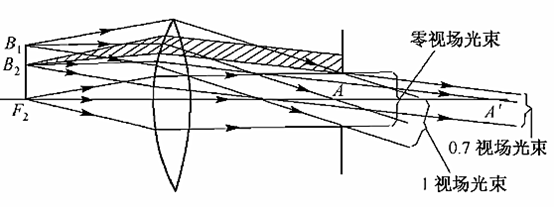
Figure 1 Schematic Diagram of Stop Spherical Aberration of Eyepiece
Let the stop spherical aberration of the eyepiece be negative, as shown in Figure 1. When the human eye is at position A, the light beams of the full field of view entirely enter the pupil, while only a portion of the light beams of the 0.7 field of view can enter the pupil. In the case of severe stop spherical aberration, the light beams of the 0.7 field of view may become completely invisible, resulting in a viewing effect with a bright edge and a dark central region.
References:
Zhang Yimo. Applied Optics. 5th Edition.
Source: WeChat Official Account 小小光 08